


The Decoupling of Outlet from Impact
Recently I had the happy task of contributing to a forthcoming issue of the American Behavioral Scientist honoring my PhD advisor, Paul DiMaggio. The issue engages with different aspects of Paul’s very varied work in organizations, culture, institutional analysis, and other topics. My contribution, which you can read a draft of here, puts his most-cited paper, DiMaggio and Powell (1983), in the context of other highly-cited articles in sociology since the 1930s and tries to see what that can tell us. It tries to do that through the lens of the paper itself.
“The Iron Cage Revisited” is one of the most successful articles in the history of sociology. Web of Science says it has accumulated over thirty-two thousand citations; Google Scholar puts the figure at over seventy-seven thousand. It is the most-cited paper ever published in the American Sociological Review, and the most-cited sociology paper written in the 1980s. Its core ideas—coercive, normative, and especially mimetic isomorphism—have traveled well beyond sociology, most notably into organization studies and management.
Sociology’s top-ten most-cited papers by decade
Here’s the main figure from my paper:
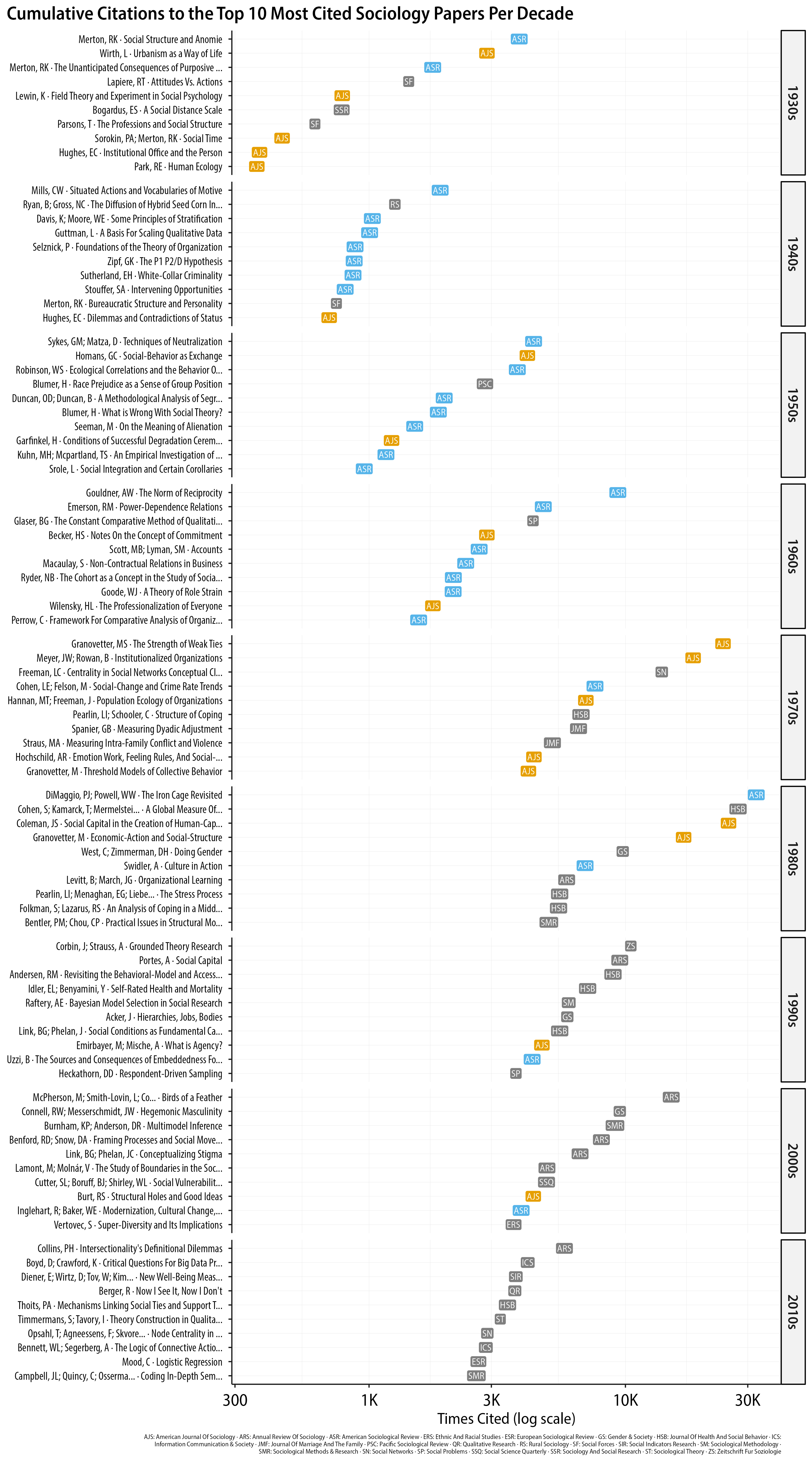
The top 10 most-cited Sociology papers from each decade, 1930s-2010s.
To make it, I took a cohort-based approach to the Web of Science citation data. That is, I divided the period from 1930 to 2019 into decades and, for each decade, found the ten sociology articles published in that decade that have the highest number of lifetime citations.1 Each label shows the journal the paper appeared in. American Sociological Review (ASR) articles are in blue. The American Journal of Sociology (AJS) is in gold. Everything else is in gray. Looking at the very top of the field this way, a few things jump out.
First, there is the sheer volume of citations accumulated by papers from the 1970s and 1980s. For example, Granovetter (1973) is “The Strength of Weak Ties”. It has over 24,000 lifetime citations. The most-cited paper from the 1930s, Merton’s “Social Structure and Anomie” (1938), has about 3,800 by comparison, despite a thirty-five-year head start. “The Iron Cage Revisited” has over 32,000. Papers from more recent decades are of course at a disadvantage simply because they’ve had less time to accumulate citations. But the advantage held by the 1970s and 1980s cohorts isn’t just a matter of time. These are the papers that benefited most from the postwar expansion of the university system, and from the subsequent growth of the citation base as more and more faculty began writing more and more papers.
Second, there’s the character of the papers themselves. Across the decades, most of the top-ten papers are either primarily theoretical or primarily methodological. They are not, for the most part, reports of findings from a particular empirical study. “The Strength of Weak Ties” does briefly sketch Granovetter’s dissertation research, but only schematically, as one illustration amongst several of the main theoretical argument. “The Iron Cage Revisited” is wholly a theory paper. So is Swidler (1986) on culture as a toolkit, West and Zimmerman (1987) on doing gender, and Collins (2015) on intersectionality. On the methods side, we have Freeman (1978) on network centrality, Bentler and Chou (1987) on structural equation models, Corbin and Strauss (1990) on grounded theory, Raftery (1995) on Bayesian model selection, Heckathorn (1997) on respondent-driven sampling, and more besides. The papers that become the most widely cited present either theories or tools. Specific findings, however important, tend not to reach this (admittedly rarefied) level of influence.
The third pattern is the one the paper is mostly about. In the 1930s, five of the top-ten papers appeared in AJS. (ASR’s first issue was in 1936 but it still managed to get two papers in the top ten from that decade.) In the 1940s and 1950s, ASR dominates, with seven of the top ten in each decade and AJS accounting for most of the rest. The 1960s look much the same: one paper from Social Problems (Glaser 1965 on the constant comparative method) and the rest from ASR or AJS. Beginning in the 1970s, though, things start to fragment, and the two flagship journals decline in prominence decade by decade. By the 2000s, just one of the ten most-cited papers comes from ASR, and none from AJS. By the 2010s, neither journal has a paper in the top ten at all. The journals that take their place—the Annual Review of Sociology, Gender & Society, Sociological Methods & Research, Social Networks, Sociological Theory—are specialist outlets or review journals, not competing general-interest journals like Social Forces. This is a complete reversal of the midcentury pattern.
“The Iron Cage Revisited” sits right at the hinge of this change. It’s a pure example of a once fairly common kind of article: a theoretically focused, self-consciously agenda-setting piece published in one of the discipline’s two leading generalist journals. It is also the high-water mark of that combination of form and outlet. Now, the raw counts in the figure favor the 1970s and 1980s. It’s natural to ask what happens if we express each paper’s citations relative to some denominator. One option is to express the citation counts as a percentage of that decade’s citation base: that is, the total number of citations, from anywhere and at any time, to all sociology articles published in that decade. Here is each decade’s most-cited paper expressed as a share of that total.
| Decade | Authors | Title | Journal | Share |
|---|---|---|---|---|
| 1930s | Merton | Social Structure and Anomie | ASR | 15.49% |
| 1940s | Mills | Situated Actions and Vocabularies of Motive | ASR | 5.08% |
| 1950s | Sykes & Matza | Techniques of Neutralization | ASR | 4.11% |
| 1960s | Gouldner | The Norm of Reciprocity | ASR | 4.56% |
| 1970s | Granovetter | The Strength of Weak Ties | AJS | 4.63% |
| 1980s | DiMaggio & Powell | The Iron Cage Revisited | ASR | 3.32% |
| 1990s | Corbin & Strauss | Grounded Theory Research | ZS | 0.68% |
| 2000s | McPherson, Smith-Lovin & Cook | Birds of a Feather | ARS | 0.62% |
| 2010s | Collins | Intersectionality’s Definitional Dilemmas | ARS | 0.26% |
Because the citation base grows sharply almost every decade, normalizing this way tends to favor older papers. Merton’s “Social Structure and Anomie” (1938) accounts for over fifteen percent of all citations to sociology papers from the 1930s. From the 1940s through the 1980s the top paper’s share sits in a band of roughly three to five percent. About one in every thirty citations to a sociology paper published in the 1980s is to “The Iron Cage Revisited.” Then, from the 1980s to the 1990s the top paper’s share drops by about an order of magnitude, while the citation base grows by about fifty percent. After that point it’s no longer possible for even the most-cited paper to command the kind of share available to the 1980s cohort.
Why did this happen?
So, from the 1920s to the 1970s, sociology’s most-cited papers were published in its two most important generalist journals. Now, ASR and AJS remain the most prestigious journals in the discipline, and publishing in them is still vitally important for establishing and consolidating a career. But, at least at the very top of the distribution, these journals no longer publish the discipline’s most-cited work. Impact has become decoupled from venue. Why?
It’s plausible to think that the shift is broadly institutional in character, and driven by the forces that DiMaggio and Powell identified. The postwar expansion of American higher education happened in two phases. First came the rapid growth of universities from the late 1940s to the end of the 1960s, bringing many more sociology departments, faculty positions, PhD programs, and journals. Then came the arrival of the students educated during that expansion into the ranks of the faculty themselves. This makes the 1970s and 1980s the era of what you might call “Boomer Sociology”, when the first postwar generation was coming into its own and the discipline reached its largest size.
At this point, there were far more academics writing far more papers, and many more places to publish them. But the most prestigious journals had been founded in earlier waves of institutionalization, and they didn’t much change their format, frequency, or the number of articles they published. As job markets tightened after the initial wave of expansion, the career payoff to publishing in a top journal rose. That changed the character of the gatekeeping role the flagships played. Journals became focal points for career competition.
Over time, ASR and AJS responded with—or gravitated toward; the particular mechanism doesn’t matter much here—a model that demanded more of the papers it published. They had to make a significant contribution on several fronts at once: a substantial empirical finding and an advance in either theory or methods, while at the same time still on a topic of interest to a wide swathe of the field. The idea of a “full package” paper became the expectation. This is a high bar! Run-of-the-mill findings couldn’t clear it. But neither, increasingly, could papers whose main contribution was a theory or a method. You can see this in the figure. After the 1980s there’s only one purely big-idea theory paper from ASR or AJS in the top ten (Emirbayer and Mische 1998’s “What Is Agency?”). The other flagship papers that make the list—Uzzi (1996) on embeddedness, Inglehart and Baker (2000) on modernization and cultural change, and Burt (2004) on structural holes and good ideas—are empirically focused studies with a strong theoretical idea attached. They are exemplars of the newer sort of ASR or AJS paper. But they are also the last papers on these lists to appear in either journal.
It’s tempting to see this as a recognizable case of normative and mimetic isomorphism. Professionalization is one of the main engines of organizational homogenization. In a field whose members are trained in similar programs, credentialed in similar ways, competing for a limited number of positions, and evaluated by somewhat vague but widely shared criteria, organizations and their outputs will tend to converge in form. Sociology’s relative lack of disciplinary consensus may have made this process more intense at the level of the elite journals in particular. (Sociology has always been the least disciplinary of the social sciences, with both the most internal disagreement on theory and methods and—relative to the other social sciences—the most representation of different positions across the field.) Editors were more likely to see themselves as setting and modeling standards for the whole field through peer review. Meanwhile, in departments, a flagship publication could act as a point of consensus amongst colleagues who otherwise disagreed strongly about theory and method. It’s hard to dismiss the value of an ASR or an AJS. (John Levi Martin has referred to this tendency as the Pax Wisconsana.)
Research literatures still principally prize good ideas and useful tools, however. People didn’t stop writing theory and methods papers, and they certainly didn’t stop citing them. It’s just that those papers stopped appearing in the flagships. Big-idea theory papers found homes in Theory and Society (for a while) or Sociological Theory. Methods contributions went to Sociological Methods & Research or Sociological Methodology. Papers developing concepts within subfields like gender, race, culture, or networks went to journals like Gender & Society or Social Networks. And the Annual Review of Sociology emerged as one of the most important venues for highly cited work in the 2000s and 2010s. Reviews have an obvious citation advantage, as they can absorb credit from the work they summarize, though the evidence on how much this matters is mixed.2 Moreover, the most-cited Annual Review pieces tend to frame a problem, set an agenda, or introduce an organizing concept. That is, they are often theory papers disguised as literature reviews.
The upshot is that the demographic expansion and steady professionalization of sociology transformed the expectations attached to people facing an often-uncertain job market. Conditions distinctive to the discipline may have increased the gatekeeping power of its flagship journals. The resulting standards were reinforced through PhD training, the job market, and the tenure process. As a result, the average quality of work in the flagships went up, papers in those journals became more similar to one another, and what ASR and AJS were likely to accept became decoupled from what, at the very highest end of the distribution, the field found most valuable to cite. Elite journals remained elite, but the character of their importance shifted along with the composition of their content. “The Iron Cage Revisited” both marks that shift and helps explain it.
-
“Sociology articles” means articles published in any journal classified as “Sociology” in the Social Sciences Citation Index. Citation counts are cumulative across all Web of Science databases, so they include citations from any field. Data and code to reproduce the analysis are available on GitHub. ↩︎
-
The worry goes back at least to Michael H. MacRoberts and Barbara R. MacRoberts, “Problems of Citation Analysis: A Critical Review,” Journal of the American Society for Information Science 40, no. 5 (1989): 342–349. For mixed evidence, see Christian Lachance, Steve Poirier, and Vincent Larivière, “The Kiss of Death? The Effect of Being Cited in a Review on Subsequent Citations,” Journal of the Association for Information Science and Technology 65, no. 7 (2014): 1501–1505; and Ruben Miranda and Esther Garcia-Carpintero, “Overcitation and Overrepresentation of Review Papers in the Most Cited Papers,” Journal of Informetrics 12, no. 4 (2018): 1015–1030. ↩︎